Chaos, Crisis, Corruption, Decline, Poverty
Introduction
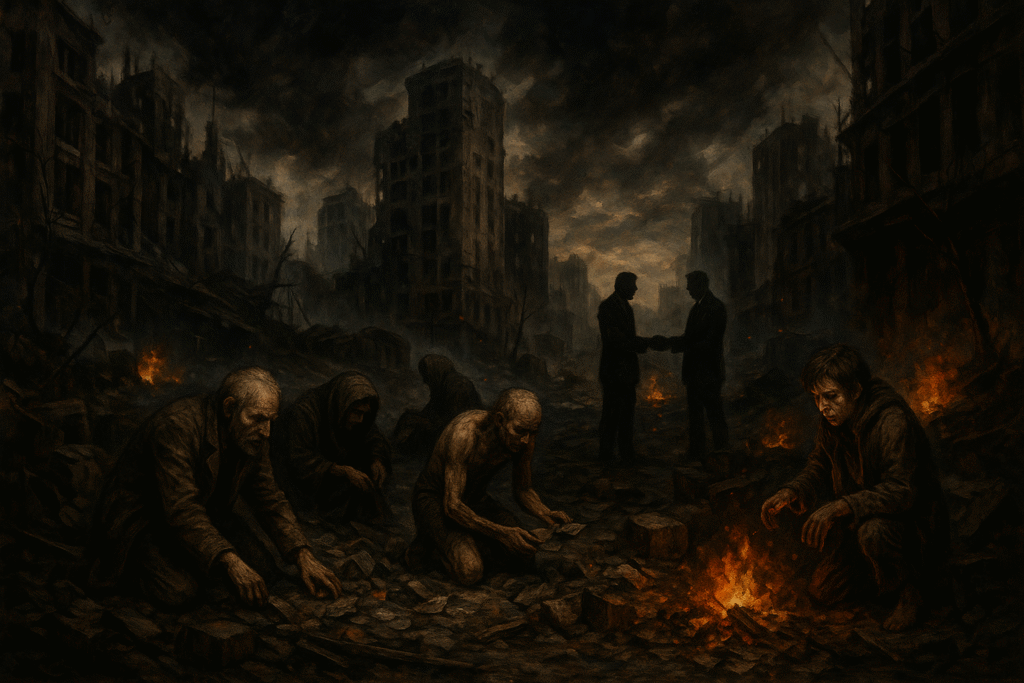
It often feels as though the ground beneath our feet is shaking. We wake up to headlines about war, corruption, and economic uncertainty. Social media scrolls past with images of wildfires, political scandals, collapsing buildings, and people protesting in the streets. Prices rise faster than wages. Cities feel crowded and chaotic. Technology threatens to take away jobs we thought were safe.
It is no surprise, then, that so many of us feel uneasy about the future. Polls across dozens of countries show the same pattern: a large majority of people believe the world is heading in the wrong direction. If you ask almost anyone, they will tell you in one form or another that everything is falling apart.
The Weight of Daily Evidence
The evidence seems to be everywhere. Rent consumes half a paycheck. The evening news leads with another shooting. Politicians trade insults instead of solutions. A new virus spreads through airports. Floods wipe out farms. Videos of corruption scandals circulate online. Every story reinforces the feeling that decline is not only real but accelerating.
And to some extent, these feelings are justified. Housing is unaffordable for millions. Inequality is glaring. Governments often appear incapable of solving deep problems. Technology does disrupt livelihoods, and climate change is already here. The sense of disorder is not a hallucination.
But there is another side to the story — one we hear far less often.
The Paradox We Live In
When we zoom out, across decades rather than news cycles, we find a paradox. By many measures, the world is better than it has ever been. People are living longer, healthier lives. Extreme poverty has fallen dramatically in just a few decades. Wars between great powers — once routine in human history — have become rare. Cities may feel crowded, but the countryside in many nations is emptying out because so many now have the freedom to move in search of opportunity.
So which is true? Is the world collapsing, or is it improving? The unsettling answer is: both.
This paradox is not new. Every generation has felt it in its own way. In the 1960s, people feared a “population bomb” that would bring mass starvation. Instead, global food production soared. In the 1980s, many believed nuclear war was inevitable. Instead, the Cold War ended without a shot fired between superpowers. In the 1990s, the internet was hailed as a tool for freedom; today it is blamed for disinformation and division. History rarely moves in a straight line.
Why Our Perceptions Tilt Negative
Still, the perception of collapse is stronger now than ever. Why?
Part of the answer lies in how we receive information. News organizations have powerful incentives to highlight conflict, scandal, and disaster. A corruption trial or a violent riot attracts far more attention than a quiet report on falling child mortality. Social media intensifies this tendency, as outrage spreads faster than calm updates. psychology also plays its part. Evolution trained us to notice threats more than opportunities — what psychologists call negativity bias. We also suffer from nostalgia bias: the “good old days” often look better in memory than they did in reality. Add in 24‑hour news cycles and constant notifications, and the result is a sense of relentless crisis.
In short, the world feels worse than it is because our brains and our information systems are designed to amplify the negative.
What This Book Attempts
This book begins from that paradox. It is an attempt to separate perception from reality, fear from fact, and noise from signal. The goal is not to deny the problems we face. They are real and pressing. But neither should we accept at face value the story of collapse that dominates our headlines and conversations.
To do this, we will look at some of the most common stories people tell about our age — about overpopulation, unemployment, violence, corruption, technology, and inequality. We will trace where those stories come from, why they feel so convincing, and how the evidence often points in a more complicated direction. Along the way we will see that humanity is not on a simple path of decline. It is on a winding road, full of setbacks and advances, fears and triumphs.
An Invitation
The introduction you are reading now is not meant to reassure you blindly, nor to scold you for feeling anxious. Instead, it is an invitation: to step back from the daily noise, to take a longer view, and to see the world as it really is — messy, surprising, and full of contradictions.
If you are ready, let us begin